
Introduction
Sometimes a single decision or event is a clear indication of something deeper, of a movement that will radically change old habits, consolidated practices, and even weltanschauungen (world views) so deeply entrenched in our ways of working that we hardly noticed them in our daily activities.
The recent decision by the European Fusion Association to create a Working Group named “AI & Fusion” is one of those events. EFA’s members are all companies involved in the fusion space, in research, development, engineering, manufacturing and testing of fusion systems. The Association’s aims are the following as listed on the Association’s website:
• The EU must accelerate innovation and find new growth engines – fusion can be that solution.
• An industry-led European Fusion Association (EFA) will drive forward a European industrial renaissance.
• A focus on accelerating the transition of fusion energy from the lab to the grid.
• Ensuring European industry’s leadership in a global fusion future.
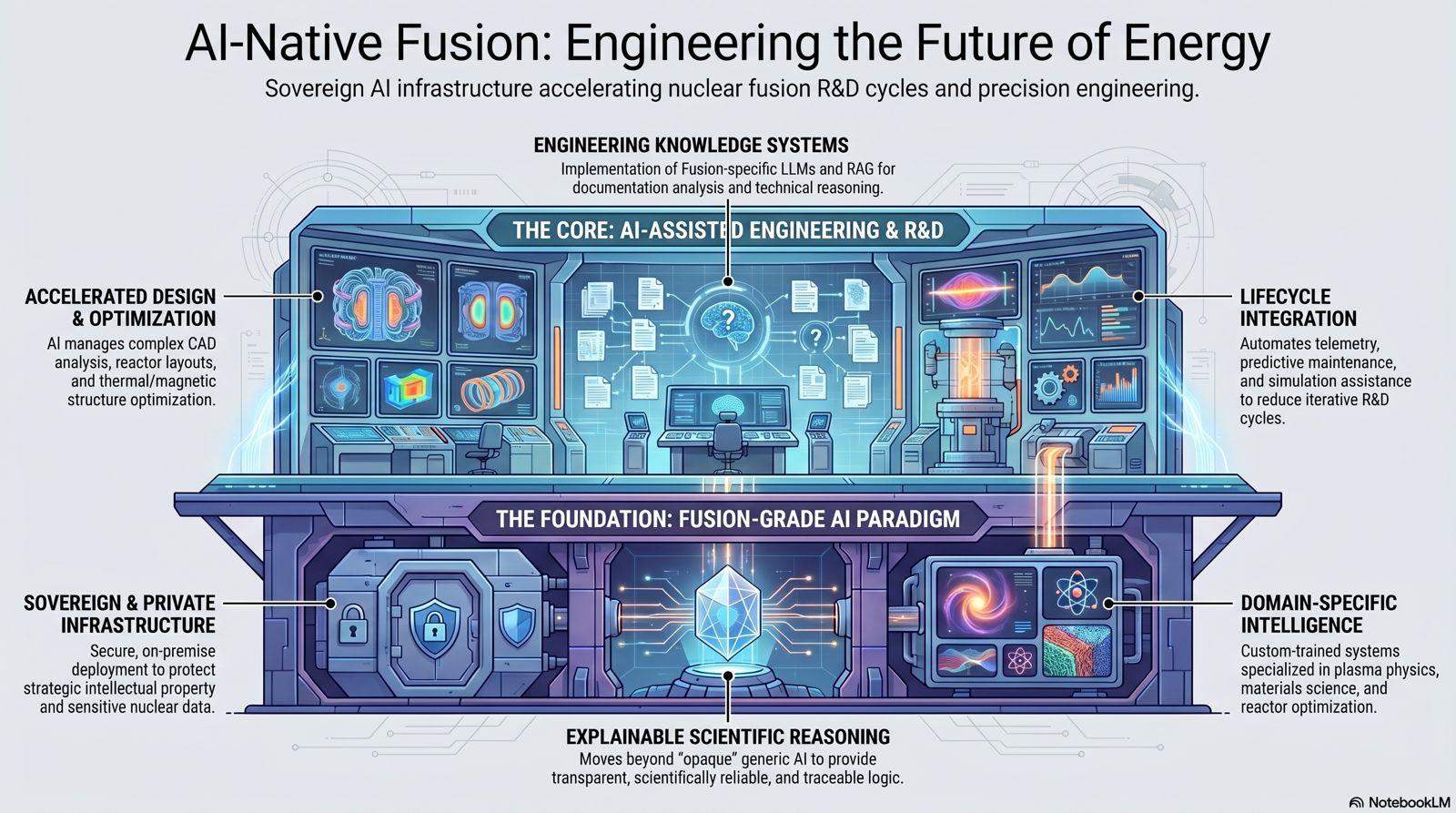
The “AI & Fusion” Working Group is the explicit acknowledgement, in my opinion, that all these four aims can be better reached through a massive use and adoption of Artificial Intelligence solutions. I would even go as far as saying that without AI these aims will hardly become reality in the near future. Because Artificial Intelligence is not just simply a technology or a set of tools, but a new way of doing things: one needs to master it well and beyond what traditional suppliers are saying and claiming, and one needs to understand its mechanisms to avoid being forever dependent on external solutions.
Let’s get into the details by showing how each of the four aims of the European Fusion Association involve and require an understanding of mastering of AI well beyond typical IT and software experience.
The EU must accelerate innovation and find new growth engines – fusion can be that solution
To accelerate innovation is practically impossible without AI solutions. Artificial Intelligence empowers engineers developing prototypes, it empowers scientists trying to solve the hard problems of physics, it reduces the cost of R&D and turns innovation from being a cost into being a competitive advantage. This is already happening in other scientific fields such as cosmetics or medical research, and it is surely true for fusion also. When physical testing and prototyping require multi-million investments it is more than reasonable to use all the resources of simulation, digital prototyping, fast-calculation techniques before taking the decision to go into physical experimentation.
An industry-led European Fusion Association (EFA) will drive forward a European industrial renaissance
In order to be labeled “European” an industrial Renaissance cannot and should not rely on non-European tools. And in the case of AI we are talking about tools that have also the intrinsic capability to absorb all the know-how, Intellectual Property (IP) and industrial secrets of anybody using it. As soon as an AI system is fed with any information, that information ceases to belong to the holder and becomes part of the knowledge of the AI system. No contractual or legal agreement can change that fact, for the simple reason that that is the only way an AI system will work, in fact it is the very essence of how AI works: to be effective it needs to learn, and once it has learned it will not forget. Strict regulations such as Information Export Controls protocols are easy to be overlooked when using an AI system, fusion companies know that and so the easy solution is to just avoid using AI at all. But the truth is that AI does not mean only external LLMs suppliers by hyperscalers, and full “private-IA” solutions are possible.
A focus on accelerating the transition of fusion energy from the lab to the grid
The transition from lab to grid is a matter of engineering, workforce training, manufacturing processes. In all these steps Artificial Intelligence has already proven its positive effects. In medical research or in cosmetics new formulas and new elements are discovered and developed with specifics algorithms designed to support scientists in labs; new drugs are imagined and their effects simulated before entering the experimental phases in order to eliminate dead-ends as much as possible. In less elaborate ways, Artificial Intelligence is simply used as a permanent repository and memory for all past experimentations and results, supporting young researchers as an old-timer experienced colleague with real-time consultable databases of everything done in the past in a specific field. There is simply no reason for not imagining the use of AI in these ways also in the field of fusion.
Ensuring European industry’s leadership in a global fusion future
If you agree with even just one of the three previous points then this conclusion should appear obvious.
What will the Working Group be “working” on?
The “AI & Fusion” WG is only two months old, we just finished defining its governing structure, and I am proud and honored to have been chosen as its first Chair to represent it within and outside of EFA. The next steps will be to define its specific objectives and especially to find the right people to make them a reality, as this is obviously not a single person or company job. This is just to say that no final decision has been taken, and nothing is yet carved in stone, what follows is just my personal choice of questions our Working Group should be searching an answer to:
AI for basic research: can scientific subjects (such as plasma dynamics or materials discovery) be approached with AI’s most advanced tools to help? Can AI in its deep-tech meaning, far from the streamline generative-AI or agentic-AI, be of help? Can advanced AI techniques such as training models with no databe used?
AI for engineering: can AI systems be built to support conceptual design and definition of fusion reactors, its components and subcomponents? Could it be possible to conceive an engineering AI-assisted activity with built-in “safety-by-design” and “compliance-by-design” functionalities?
AI for the fusion workforce: can fusion knowledge (both formal and informal, process or experience-based) be somehow condensed in a set of AI systems which could support the future fusion workforce in training, experiencing, and getting the right certifications for the job?
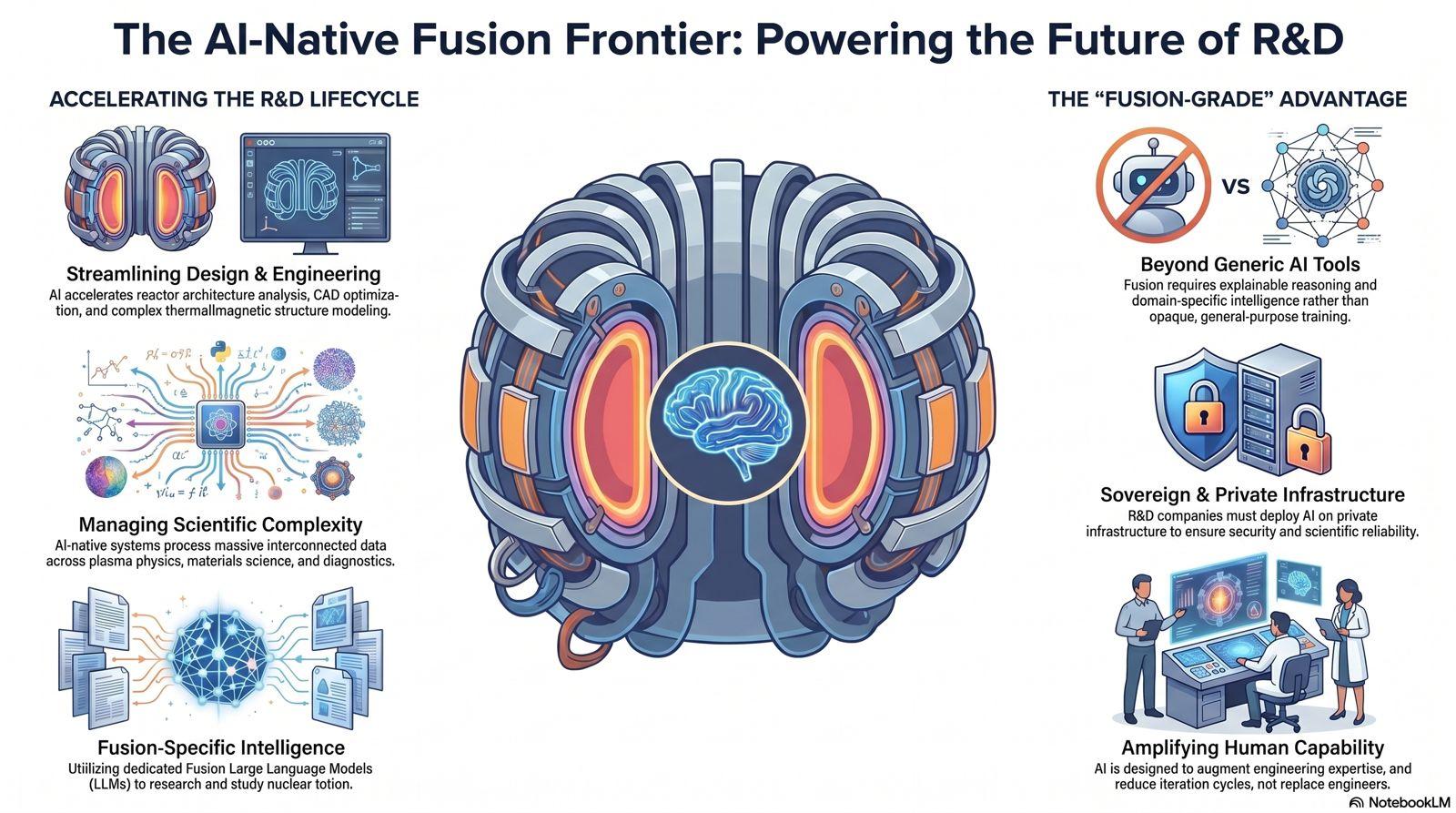
These are some of the topics our WG will be working on for the coming months. We will need and solicit experts’ advice, and we will try to involve other AI companies in the process. But the most important issue, the one that we will need the rest of EFA members to participate in, is the following: how do we pool the know-how and the experience of our members to authentically create an Artificial Intelligence knowledge base worth of the European fusion industry? Each company has legitimate goals and interests, so how do we reconcile that with the “European industry’s leadership in a global fusion future” that EFA advocates?
The debate is on. Join us!